

The power of psychology is often forgotten in football.
People make the game complicated and it’s great fun to analyse the intracicies, whether you’re an acolyte of xG or not.
But make no mistake, Rangers now have the psychological advantage in this rivalry.
The no-fans thing might mean the results are fairly arbitrary home wins. Regardless, something has changed here, you could sense it yesterday.
Ironically, it’s Celtic’s failure to change which has landed us in this situation.
Now, Celtic feel absolutely lost when it comes to big games outwith the domestic churn.
Don’t get me wrong, Henri Matisse would be happy with the level of flair Celtic have added over the summer.
There is pace, technique and attacking talent. Haissem Hassan can beat a man and cross a ball. Camilo Durán has shown flashes of a superstar. Benjamin Nygren can produce and deliver numbers. Kasper Høgh has pedigree but still needs to settle.
However, right through the middle of the team, at its actual core, there is a huge problem.
For a dominant club, the first sign of decline isn’t always losing. It’s losing the ability to decide what kind of game is being played by controlling possession and tempo on the ball – and maintaining a consistent defensive press and shape when off it.
That is why the significance of this 3-0 defeat goes beyond a place in the Premier Sports Cup semi-finals.
Rangers looked like a proper Rangers team again. They looked comfortable making the game physical and uncomfortable. They looked as though they believed Celtic could be got at.
And Celtic looked passive. That word cropped up again.
Callum McGregor after LASK: “passive”.
Scott Brown after Rangers: “passive”.
Rangers pressed aggressively, competed for everything and dictated what kind of game was going to be played. Celtic spent the entire afternoon reacting to them.
It’s now clear the Hoops need to find a spine. We need to get nastier, and we’ve known that for a while.
You don’t need every midfielder to be a destroyer. Football has moved on from that. But somebody still has to provide midfield ballast. Somebody has to run, disrupt, win an ugly second ball and be a pain in the arse to play against.
And passivity in this context isn’t simply about effort. It is what Celtic look like when an opponent takes control of a game and they don’t know how to take it back.
That brings us inevitably to McGregor.
Callum McGregor is being asked to be peak N’Golo Kanté right now.
It is easy to forget what kind of player he was before Brendan Rodgers turned him into the fulcrum of Celtic’s midfield.
McGregor played wide. He played further forward. He got into the box and scored goals.
Rodgers gradually made him the man Celtic played through, and he became outstanding at it.
But when that process started, Scott Brown was there too. There was a spine around McGregor.
Now he is expected to be the spine, as Celtic’s first receiver, organiser, playmaker, defensive screen and, when somebody presses them, the escape route as well.
Him being unable to do all of that is not unreasonable so in no way is this me saying McGregor is finished.
It is me asking why Celtic have constructed a midfield which places quite so much responsibility on one player. Especially when that player is beginning to show signs of age and, perhaps, slight decline.
Derek McInnes’ plan this Sunday was hardly revolutionary. We’ve seen it before.
Make it difficult for Celtic to find McGregor and that stops the whole machine. Mika Baur is clearly a talented footballer, but the blend isn’t right. Celtic have too many midfielders whose natural instinct is to affect the game going forward and not enough who give the team a genuine base.
The result is a strange chasm between defence and attack.
Once that develops, all that flamboyance around the outside starts to become irrelevant.
Celtic are still trying to play through pressure in a way recognisable from Rodgers’ football, but without all of the pieces which made that football work.
If the goalkeeper cannot become the spare man – and Sam Johnstone certainly struggled with that – and McGregor is marked and nobody else can break a line, Celtic have to be able to do something else. At the moment, they prove unable to.
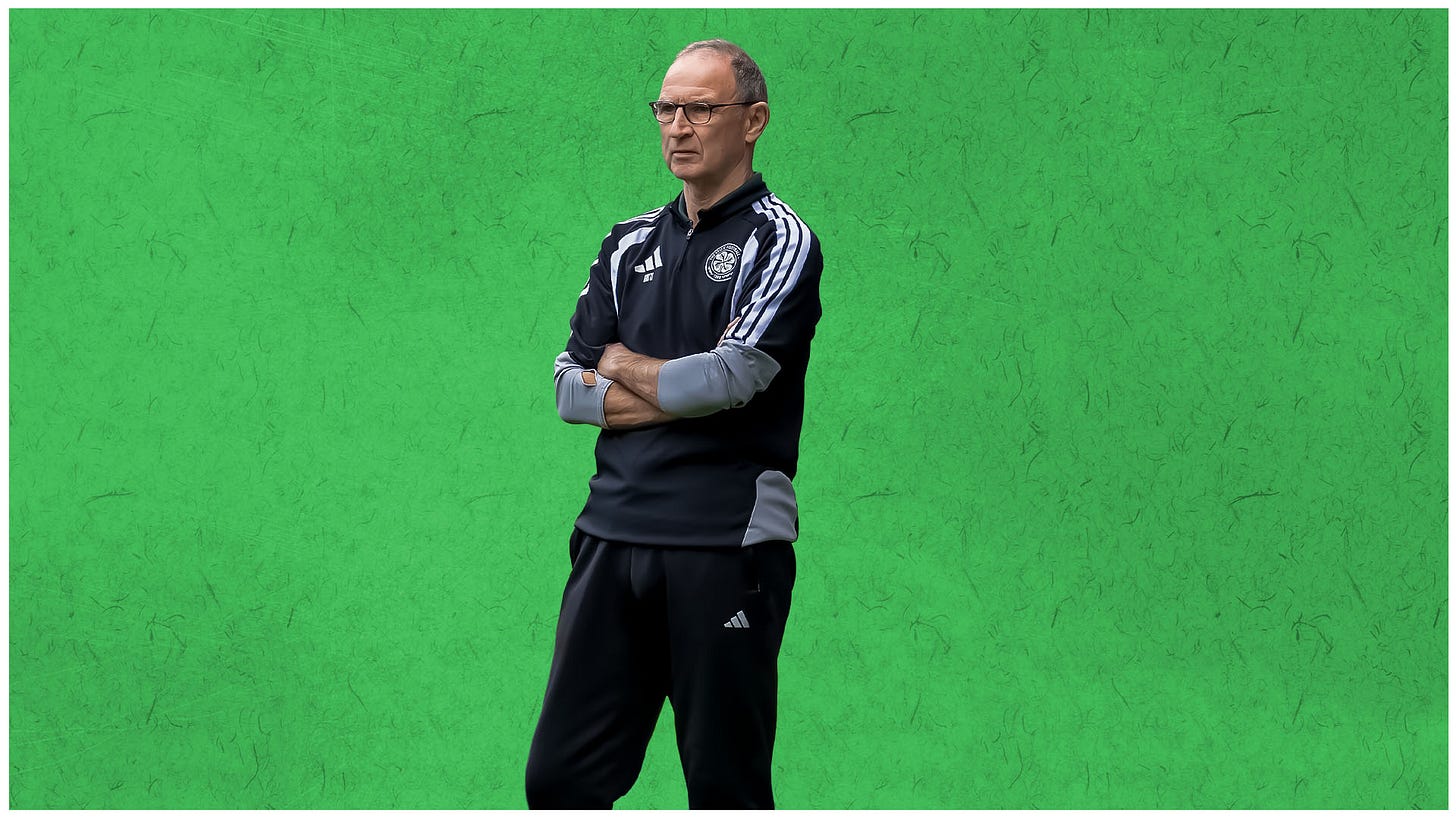
There is a certain irony in Martin O’Neill managing a team seemingly reluctant to play in perhaps a more direct fashion.
O’Neill said afterwards that the game ultimately comes down to something simple: “you have to compete” – and he’s absolutely right.
The more worrying part is that he also knew what Rangers were going to bring and Celtic still had no convincing answer.
That is the nexus where football and psychology meet. Rangers now know they can impose this kind of game on Celtic.
Celtic have to prove next Sunday that they can impose something back.
Because if Rangers walk into Celtic Park, attack the same weakness and dictate the game again, this potentially changes the balance of power completely.
It becomes the way to play Celtic – while Celtic still need to find their way to play.