

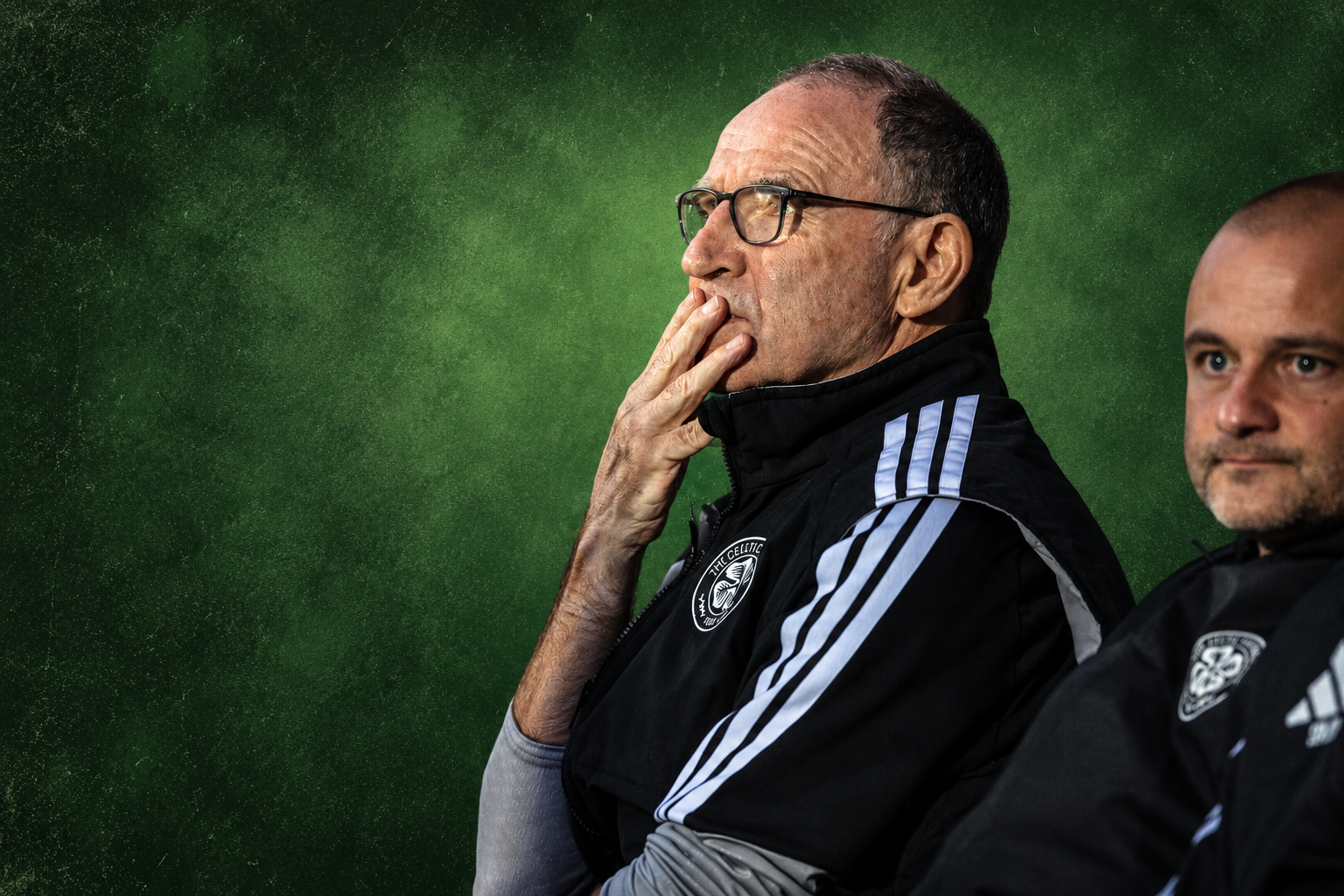
Last night's 2-2 draw with Dundee United at Celtic Park was the latest in a growing collection of performances that have left supporters scratching their heads.
There is something fundamentally disjointed about Celtic this season that belies a four-point lead at the top of the Scottish Premiership.
At times, this team can produce moments of quality. Individual players can still make things happen, and there are spells when Celtic look capable of imposing themselves on opponents domestically. The 7-1 thumping of Hearts is the prime example - an error strewn performance from last season's runners up was ruthlessly punished.
But those moments are increasingly difficult to reconcile with the overall performances. Celtic are playing in moments rather than as a coherent team. And we get away with it most weeks in domestic football.
There is no clearly identifiable footballing identity. No obvious sense that the team is developing towards something. And perhaps most worryingly, there is very little evidence of improvement in some of the fundamental areas this Celtic team is lacking in.
A Team Without Structure
The problems are particularly apparent when Celtic don't have possession. This team is passive, frequently open and hugely susceptible to counterattacks. The distances between players and units often appear too big, leaving opponents with opportunities to progress through areas of the pitch that should be far better protected.
Even amidst the 'very strong' second half performance that saw Celtic rescue a point from the game, Dundee Utd were gifted a glaring chance on the counter attack following a Celtic corner, Abdoulaye Yoro charged from 20 yards inside his own half with no one between him and Sam Johnstone in the Celtic goal. Yoro ran out of steam and Mika Baur's lung-bursting run applied enough pressure to allow Callum McGregor to intercept.
But in that solitary action, you see the Celtic conundrum. In Europe, those situations end in a goal for the opposition seven or eight times out of ten. Domestically, you get let off the hook.
The frequency of these moments this season tell you something about the organisation of the team without the ball. Proper teams have recognisable principles. Players know how they should react when possession is lost, and where their teammates are likely to be positioned. At Celtic, those relationships often look uncertain and the team lacks any idea of how to press as a connected unit.
The result is a team that can dominate periods of possession without ever appearing particularly secure. And when possession breaks down, we are so easy to play through.
The Half-Time Changes
It's clear that Martin O'Neill still doesn't know his best team.
Celtic have made half-time substitutions in 6 of their last 9 games in all competitions. Only Jota's introduction for Osmand at half-time v. Hearts can be explained as enforced. But when significant changes are repeatedly required after just 45 minutes, it raises legitimate questions about the clarity of the manager's thinking.
Kasper Høgh is in desperate need of confidence and while the Dane's performances have left a lot to be desired recently, you do wonder how confidence can be garnered from being hooked at half-time on twice in the past fortnight.
The uncertainty surrounding the goalkeeping position is maybe the most alarming of all. As we approach November, Martin O'Neill has acknowledged that he is still unsure who his first-choice goalkeeper should be, suggesting that he might reach a conclusion over the coming weeks:
"Sam, yeah, I thought he did fine, really fine in the game. So it'll take us a few weeks before we find out who will stay in goal for hopefully the rest of the season."
That is a remarkable position for Celtic to find themselves in at this stage of the season. We have reached the end of October without establishing a settled team or a consistent way of playing. That should concern everyone associated with the club.
This is a coaching staff continually searching for the right combination without ever quite finding it. Rather than building relationships and establishing continuity, Celtic seem trapped in a cycle of experimentation.
And you can't shake the feeling that this is a coaching staff without a plan appointed by a football club without a plan.
The Martin O'Neill Paradox
None of this should be interpreted as an attempt to diminish Martin O'Neill's contribution to Celtic.
His place in the club's history is secure, but there is an uncomfortable reality about his appointment. It looks and feels like a temporary solution. We all know it's a temporary solution - and that brings a strange energy.
Defeats, and even draws, can often trigger crisis talk around Celtic. But the only world where defeats and poor performances can be met with perspective is when there is a consensus that the football club is going somewhere.
Can anyone tell me where Celtic are going?